


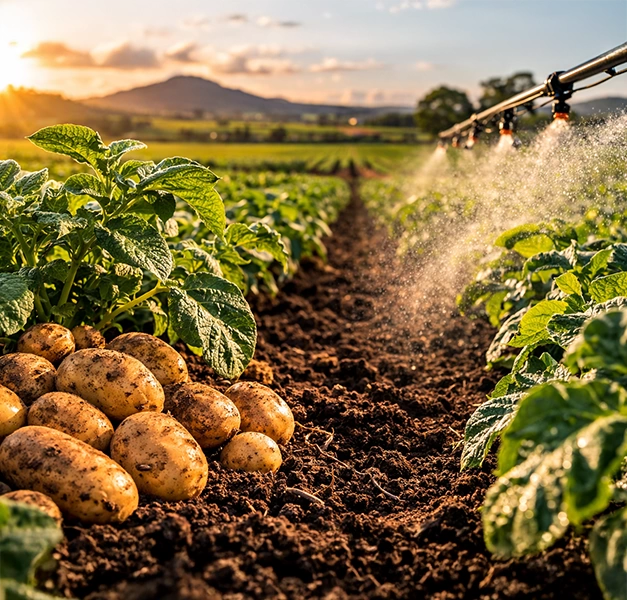
For large-scale agro-holdings and cooperatives in Kenya, the rising cost of chemical inputs and the declining effectiveness of traditional fungicides are no longer just operational hurdles—they are threats to business survival. As pathogens develop resistance and global export markets tighten regulations on chemical residues (MRLs), a shift to biological integration is a financial necessity.
This report analyzes the Return on Investment (ROI) of transitioning to EcoRic, a high-concentration Bacillus subtilis BR-1256 preparation, using a specialized "Shield & Spray" methodology.
- The Strategy: Precision Application (Shield & Spray)
To maximize cost-efficiency, the EcoRic protocol eliminates wasteful soil drenching, focusing instead on two critical contact points:
- The Shield (Pre-planting): Soaking potato tubers or seedling roots in an EcoRic solution (1L per ton). This ensures that the beneficial bacteria colonize the plant’s "birth zone" immediately, creating a biological barrier against soil-borne pathogens.
- The Spray (Vegetation): Foliar application (2 L/ha) during key growth stages. This maintains Induced Systemic Resistance (ISR)—essentially keeping the plant’s immune system "vaccinated" and active against infections and environmental stress.
- Direct Economic Benefits: Slashing Input Costs
The transition to EcoRic allows agribusinesses to significantly optimize their budget in two major categories:
- Reduction in Crop Protection Products (CPPs)
Aggressive chemical fungicides, especially copper-based bactericides, are expensive and often require frequent re-application due to resistance.
- Chemical Savings: By integrating EcoRic, farms can reduce the use of expensive chemical fungicides by 30% to 50%.
- Example: On large flower farms, chemical costs can drop from $180/ha to approximately $42/ha when EcoRic is used as the primary preventative tool.
- Optimization of Mineral Fertilizers (NRC)
EcoRic’s metabolic activity helps the plant utilize nutrients more efficiently.
- Fertilizer Savings: Trials have shown that mineral fertilizer (NPK/DAP) applications can be reduced by 30% to 50% without a loss in yield, as EcoRic increases the availability of phosphorus and nitrogen already present in the soil.
- ROI Calculation for a 10-Hectare Commercial Plot
Based on average data for potato and vegetable production in Kenya:
| Expense Category | Traditional Chemical Scheme (10 Ha) | EcoRic Integrated Scheme (10 Ha) |
| Fungicides/Bactericides | KSH 180,000 | KSH 70,000 |
| Mineral Fertilizers | KSH 350,000 | KSH 210,000 |
| EcoRic Product Cost | KSH 0 | KSH 60,000 |
| Total Input Costs | KSH 530,000 | KSH 340,000 |
| Yield (Avg Market Value) | KSH 1,500,000 | KSH 1,875,000 (+25%) |
| Net Profit | KSH 970,000 | KSH 1,535,000 |
The ROI Breakdown:
- Direct Savings: KSH 190,000 saved on chemicals and fertilizers.
- Increased Revenue: KSH 375,000 earned through higher yield and better quality (size/shelf life).
- Profit Multiplier: For every 1 KSH invested in the EcoRic protocol, the agribusiness realizes a 7.5 KSH return in combined savings and profit.
- Strategic Advantages for Export Cooperatives
For cooperatives focused on international markets (EU, UAE), the ROI extends beyond the balance sheet:
- Zero Chemical Residues: EcoRic leaves no toxic traces, ensuring 100% compliance with global export standards and avoiding costly shipment rejections.
- Soil Restoration: Since the preparation is used as a foliar spray and seedling soak, it stimulates the plant's own biology to restore the rhizosphere naturally, ensuring long-term field productivity.
- Resistance Management: EcoRic provides a stable fungicidal effect without the "habituation" or resistance common in synthetic chemicals.
Conclusion
For the modern agro-holding, EcoRic is not just a biological alternative; it is a financial instrument for risk mitigation. By adopting the Shield & Spray method, cooperatives can drastically lower their "break-even" point, protect their margins against rising input costs, and ensure a healthy, export-ready harvest.
The math is clear: Survival in today's market requires the efficiency of EcoRic.