


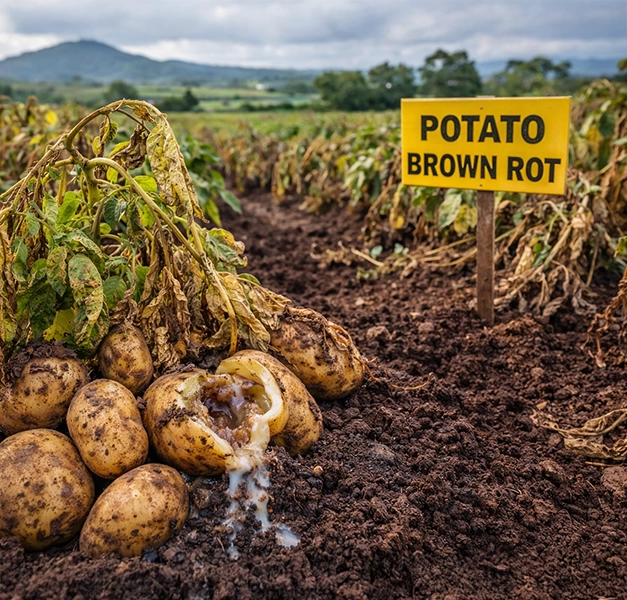
In the Kenyan highlands, from Nyandarua to Meru, one name strikes fear into the hearts of potato farmers: Brown Rot (Bacterial Wilt). Caused by the resilient bacterium Ralstonia solanacearum, this disease has historically been a "death sentence" for entire harvests. However, as we look toward 2026, the arrival of advanced microbiological tools like EcoRic is shifting the narrative.
The question is no longer if it can be solved, but how efficiently you apply the solution.
- The 2026 Reality: Why Traditional Methods Fail
For years, farmers have tried to "disinfect" the soil with heavy chemicals, but Ralstonia can survive deep in the earth for up to a decade. The modern farmer knows that success lies not in sterilization, but in Bio-Priming and Active Immunity.
- The EcoRic Strategy: The "Shield & Spray" Protocol
To maximize the effectiveness of EcoRic (Bacillus subtilis BR-1256) while maintaining cost-efficiency, we follow a strict two-stage application process that avoids wasteful soil drenching.
Stage 1: Tuber Priming (The Seed Shield)
The battle against Brown Rot starts before the potato is in the ground.
- The Action: Before planting, soak the seed tubers in an EcoRic solution (1:100 dilution) for 30 minutes or spray them thoroughly with a fine mist (1–2 L of EcoRic per ton of tubers).
- The Result: This creates a biological "shield" directly on the tuber. The Bacillus subtilis colonizes the sprouting eyes, physically blocking the entry of soil-borne bacteria.
Stage 2: Foliar Fortification (The Booster Shot)
As the plant grows, it faces external stressors and potential infection through stem wounds.
- The Action: During the active growing season, apply EcoRic as a foliar spray at a rate of 1.2–2 L/ha. Focus on the 3–5 leaf stage and repeat every 14 days, especially during humid periods.
- The Result: Through Induced Systemic Resistance (ISR), the plant’s internal immune system is "turned on." The leaves absorb the metabolites, signaling the entire plant to strengthen its cell walls and produce natural anti-bacterial proteins.
- Economic Calculations: The ROI of Survival
For a commercial potato farmer in Kenya, the financial difference between "Chemical-Only" and "EcoRic-Integrated" farming is stark.
| Financial Metric (per Acre) | Traditional Chemical Protection | EcoRic "Shield & Spray" Scheme |
| Bactericide/Fungicide Costs | KSH 12,000 – 15,000 | KSH 5,000 – 7,000 |
| Fertilizer Expenditure (NRC) | KSH 18,000 | KSH 11,000 (30-50% reduction) |
| Risk of Total Loss (Wilt) | 40% – 100% | < 10% |
| Yield (Bags per Acre) | 15 – 25 bags | 35 – 45 bags |
The ROI Breakdown:
- Direct Savings: By reducing expensive copper bactericides and mineral fertilizers, you save approximately KSH 15,000 per acre.
- Yield Bonus: An extra 15–20 bags of potatoes (at an average price of KSH 3,000 per bag) adds KSH 45,000 – 60,000 to your top line.
- Total Return: Every 1 KSH invested in the EcoRic protocol returns 6 to 9 KSH in combined savings and increased harvest value.
- Conclusion: A Solvable Task
In 2026, Brown Rot is no longer a mystery. It is a manageable biological challenge. By moving away from ineffective soil drenching and focusing on Tuber Priming and Foliar Immunity, Kenyan farmers can secure their food supply and their profits.
Don't wait for the wilt. Secure your seeds, spray your crop, and secure your future