


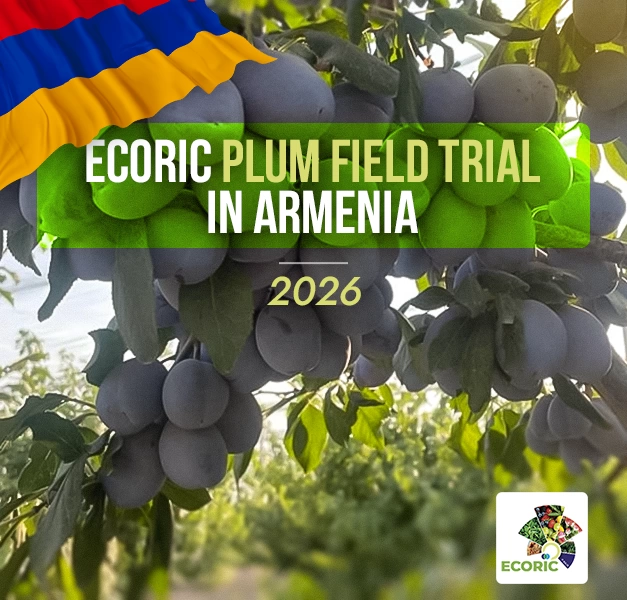
A completed EcoRic field trial on plum trees in Armenia during the 2026 growing season produced an important result: although rainy weather during flowering reduced pollination and ultimately limited total yield, the fruit that developed remained clean, firm and largely free from visible rot and spotting.
During the 2026 growing season, EcoRic was tested on plum trees in Armenia as part of a practical field programme designed to evaluate its performance under real orchard conditions. The season presented an important challenge from the very beginning. Plum trees entered spring in good condition and produced strong flowering. However, during the critical pollination period, rainy weather developed. Bee activity declined significantly, resulting in poor pollination of part of the flowers.
As a consequence, the orchard produced less fruit than in 2025.
This makes the trial particularly useful from an agronomic point of view because it demonstrates why yield and fruit quality must be evaluated separately.
The EcoRic Application Programme
The plum trees received:
- 3 EcoRic spray applications
- 10-day intervals between applications
- 2 litres of EcoRic per hectare per application
The total EcoRic input during the three-treatment programme was therefore 6 litres per hectare. The objective was to support plant health and reduce disease pressure during the period when young fruit was developing.
Rain During Flowering Limited Yield Potential
The lower harvest recorded in 2026 should not be interpreted as a negative response to EcoRic. The principal limiting factor occurred before normal fruit development could take place. Pollination is essential for fruit set. When rainfall restricts bee activity during flowering, a proportion of flowers may remain insufficiently pollinated and fail to develop into fruit. No foliar or biological treatment applied later can replace pollination that did not occur. For this reason, the most relevant outcome of the trial was not the total number of fruits harvested but the condition of the fruit that successfully developed.

What Was Observed at Harvest?
The harvested plums showed a strong overall quality profile.
Field observations recorded:
- clean fruit surfaces
- firm fruit
- very limited visible spotting
- no significant visible fruit rot
- healthy external appearance
- a high proportion of commercially acceptable fruit
The difference between yield quantity and marketable quality is particularly important for commercial fruit growers. A farm is ultimately paid for fruit that can be sold, not simply for the biological weight produced by the trees. Fruit affected by rot, severe spotting or surface damage may be downgraded or rejected even when overall yield is high.
The 2026 Armenian trial therefore produced an encouraging quality result under a season in which pollination conditions were far from ideal.
Disease Management Is Especially Important in Wet Periods
Wet conditions during flowering and fruit development can increase disease pressure in stone-fruit orchards. Moist flowers, young fruit and plant tissues can create favourable conditions for a range of fungal infections. Later in the season, damaged or infected fruit can also become more vulnerable to storage and pre-harvest rots. For growers, this makes preventive crop-health management particularly important. The EcoRic-treated plum trees finished the trial with fruit that was visually clean and firm, with very little observed rot or spotting.

What the Trial Does and Does Not Prove
The 2026 programme was a practical production trial rather than a replicated scientific experiment. It therefore provides useful field evidence but should not be used to claim a precise percentage reduction in disease or increase in yield.
The trial supports three important observations:
- Yield was primarily constrained by poor pollination during rainy flowering conditions.
- Fruit that successfully developed showed strong visual quality.
- Rot and visible surface damage were minimal in the harvested crop.
Future trials should include an untreated or standard-programme control and record disease incidence, average fruit weight, marketable yield and storage losses.
Implications for Plum Growers
For professional plum production, the objective of a crop-health programme should not be limited to increasing total yield.
Growers should also monitor:
- fruit set
- average fruit weight
- fruit diameter
- disease incidence
- percentage of fruit affected by rot
- percentage of clean fruit
- marketable yield
- storage performance
The Armenian experience suggests that EcoRic deserves further evaluation as part of an integrated programme focused on protecting the quality of developing fruit.
Conclusion
The completed 2026 plum trial in Armenia took place under challenging spring conditions. Rain during flowering restricted pollinator activity and reduced potential fruit set compared with the previous season. However, the fruit that developed showed a notably positive quality profile: firm, clean plums with minimal visible spotting and rot. For growers, this distinction is important. The season demonstrated that weather may determine how much fruit is set, while crop-management decisions can still play an important role in determining the quality and commercial value of the fruit that reaches harvest.