


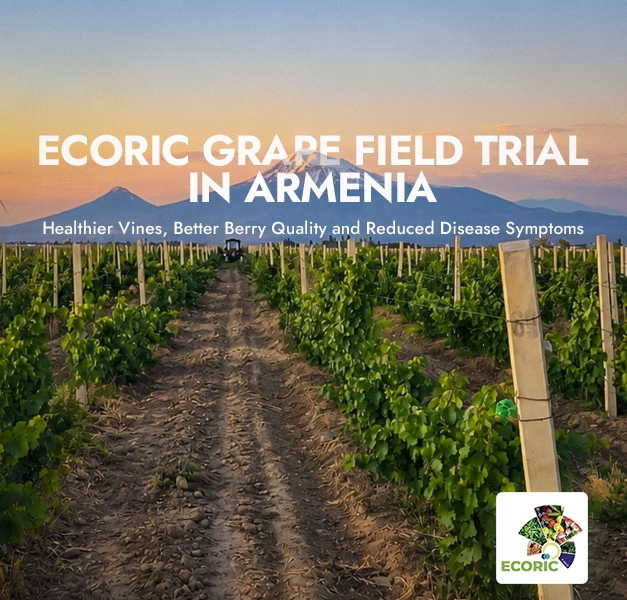
A completed 2026 EcoRic grape trial in Armenia showed healthier foliage and vines, improved berry and cluster quality and reduced visible disease symptoms, supporting further evaluation of EcoRic within integrated vineyard management programmes.
Grape production requires continuous attention to the health of leaves, shoots and developing clusters. A disease problem beginning early in the season can affect berry development and final cluster quality months later. For this reason, biological crop-health programmes for vineyards should be evaluated throughout the full growing cycle rather than only immediately before harvest.
During the 2026 season, EcoRic was tested on grapevines in Armenia under practical vineyard conditions. By the completion of the trial, positive changes had been observed in both vine health and berry quality.
Field Results
The principal observations were:
- healthier-looking vines;
- strong green foliage;
- healthy developing shoots;
- improved berry quality;
- healthy-looking clusters;
- reduced visible disease symptoms;
- improved overall phytosanitary condition of the crop.

The trial did not include sufficient structured disease scoring to calculate a scientifically defensible percentage reduction in infection. For this reason, the result should be described as a positive field observation rather than a quantified disease-control claim.
Why Healthy Leaves Matter for Grape Production
The grapevine's leaf canopy supports photosynthesis and supplies the developing crop with energy. Maintaining a functional, healthy canopy therefore matters throughout the period of berry development and ripening. Severe disease pressure can reduce effective leaf area and may also directly affect young berries and clusters. The condition of both foliage and fruit should therefore be considered when evaluating a biological programme. The EcoRic-treated vines in the Armenian trial finished the season with healthy-looking foliage and good cluster quality.
Cluster Health as a Commercial Indicator
For table-grape production, visual cluster quality has direct commercial importance.
Growers need to monitor:
- berry appearance
- berry size
- damaged berries
- cracking
- cluster rot
- uniformity
- firmness
- soluble solids
For wine grapes, additional parameters become important:
- °Brix
- juice pH
- titratable acidity
- berry weight
- technological maturity
The next Armenian EcoRic trial should therefore adapt its measurements according to whether the vineyard is producing table or wine grapes.
Disease Incidence Should Be Measured Numerically
Two particularly useful measurements are:
Disease Incidence
The percentage of leaves or clusters showing symptoms.
For example: 15 affected clusters from a sample of 100 = 15% disease incidence.
Disease Severity
The approximate percentage of tissue affected on each leaf or cluster. This distinction allows agronomists to determine whether a programme reduces:
- the number of infected plants or clusters;
- the intensity of infection;
- or both.
Recommended Sampling Method
For each trial block, agronomists should examine at least: 100 randomly selected clusters and 100 leaves. Assessments should be repeated at key crop-development stages. The same procedure should be used in the EcoRic-treated and reference blocks.
At harvest, growers should measure:
- yield per vine;
- yield per hectare;
- average cluster weight;
- average berry weight;
- healthy-cluster percentage;
- rot incidence;
- berry cracking;
- °Brix;
- marketable yield.
EcoRic Should Be Evaluated as Part of IPM
The objective of modern biological crop protection should not necessarily be to replace every conventional input. A more practical approach is to determine how biological products can be integrated with:
- canopy management;
- vineyard sanitation;
- irrigation management;
- nutrition;
- disease monitoring;
- necessary crop-protection treatments.
The 2026 Armenian experience suggests that EcoRic deserves further testing within this type of integrated programme.
What the 2026 Trial Demonstrated
The completed trial produced a consistent combination of observations: healthier foliage + healthy vines + improved berry quality + fewer visible disease symptoms.
The absence of a fully quantified control means that it is too early to assign a precise percentage benefit. However, the field response supports expansion into a controlled vineyard study.
Conclusion
The completed EcoRic grape field trial in Armenia in 2026 produced encouraging results. Treated vines showed a healthy overall appearance, good foliage condition, improved berry and cluster quality and reduced visible signs of disease.
The next step is to quantify these observations using:
- disease incidence
- disease severity
- cluster quality
- berry weight
- °Brix
- marketable yield
- harvest quality
With these measurements, future trials can determine not only whether vines look healthier, but how much additional commercially usable crop can be produced under a structured EcoRic programme.