


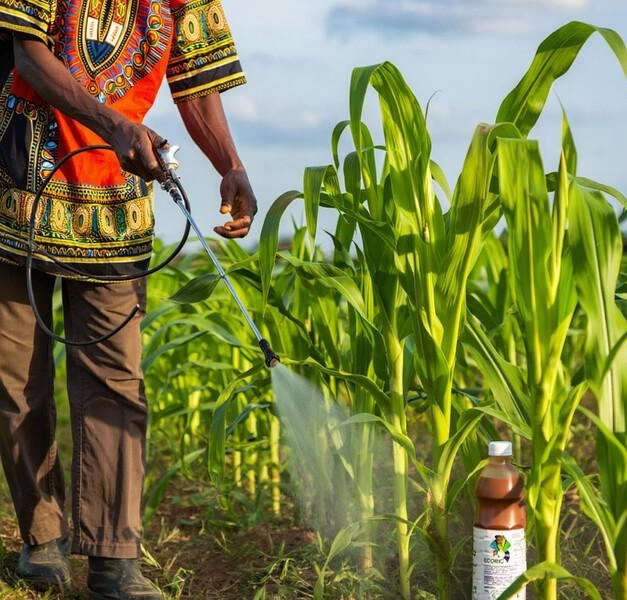
EcoRic Field Trial Report: Initial Results at Mr. Kimathi's Farm, Meru County
EcoRic, a microbiological product based on the pure monostrain Bacillus subtilis BR-1256, continues to demonstrate excellent field results across Kenya. One of the most detailed preliminary reports comes from Mr. Kimathi's farm in Mikumbune, Meru County, Kenya, where EcoRic was used on maize under real-world field conditions.
Maize plays a key role in food security and rural livelihoods in Kenya, yet farmers often face erratic rainfall, fungal diseases, soil depletion, and pest stress. EcoRic is designed to address these challenges by enhancing root system strength, nutrient uptake, and plant resilience to a variety of climatic conditions.
Below is a brief description of the trial conditions, application method, and plant response after three spray cycles. Testing of the product was conducted by Mike Mutuma, a specialist in the Complex Food Agro agronomy team.
Farm Information
Farmer: Mr. Kimathi
Location: Mikumbune, Meru County, Kenya
Farm Type: Smallholder farm, mixed farming
Test Area: 0.125 hectares
Main Crops: Maize, Coffee, Bananas
Soil Type: Dark red loam, fertile, well-drained, high in organic matter
Dark red loam soil is known for its strong structure, good aeration, and high water-holding capacity, making it ideal for evaluating microbial products like EcoRic.
Composition and Purpose of EcoRic
EcoRic is a microbiological product based on a pure, single-strain culture of Bacillus subtilis BR-1256. It is certified, non-GMO, food-grade, and safe for farmers, animals, and the environment.
Main functions of the product:
- suppression of fungal pathogens
- rapid plant recovery after infections
- improvement of leaf and stem structure
- increased plant viability and stress resistance
Application Information
First Spray
Date: October 13, 2025
Time: 5:30 PM (cool evening)
Equipment: Backpack sprayer (20 L)
Dosage for a 0.125 ha test plot: 125 ml EcoRic, 62.5 L of clean water
Total solution consumption: ≈62.6 L (3 backpack loads)
Weather terms: Temperature: ~21°C, Precipitation: 0 mm, calm winds - ideal conditions for spraying
 Photo: 1st treatment
Observations 10 days after First spray
After the first application of EcoRic, clear differences were observed between treated and untreated corn crops:
- increased leaf size and crop height, visible vegetative stimulation
- healing of fungal infection sites, indicating active suppression and restoration
- higher chlorophyll intensity, leaves acquired a more saturated green color
These responses indicate improved photosynthesis efficiency and a reduction in fungal load in just 10 days.

Photo October 23, 2025, 10 days after the first spray of EcoRic Biofungicide  Photo October 25, 2025, Unsprayed portion
Second spray:
Date: October 25, 2025
Time: 8:30 AM (cool morning)
Dosage: Same concentration and method as the first spray
Next observation date: November 4, 2025

Photo 2nd treatment
Photo October 25, 2025
Observations: 10 days after the second spray
The cumulative effect of EcoRic became even more pronounced after the second treatment cycle:
- further improvement in plant health compared to untreated control plants
- uniform dark green leaf coloration on treated crops, indicating high activity Chlorophyll
- Noticeably taller plants with wider stems, indicating better structural growth and vigor.
These results are consistent with the expected action of EcoRic as a biostimulant and bioprotectant.
Third spray:
Date: November 4, 2025
Time: ~6:00 PM

Photo 3rd treatment
Photo November 4, 2025
Cumulative results after the third spray:
EcoRic demonstrated:
- Accelerated vegetative growth
- Healthier leaves with richer green pigmentation
- Visible recovery of previously infected areas
- Increased plant height and stem thickness
- Higher overall vigor compared to untreated corn
These results confirm the high potential of EcoRic as a biological alternative to chemical fungicides, providing both plant protection and stimulation.
ComplexFoodAgro continues to analyze the results of EcoRic testing on various crops and will share them with farmers, agronomists, and partners across Kenya.