


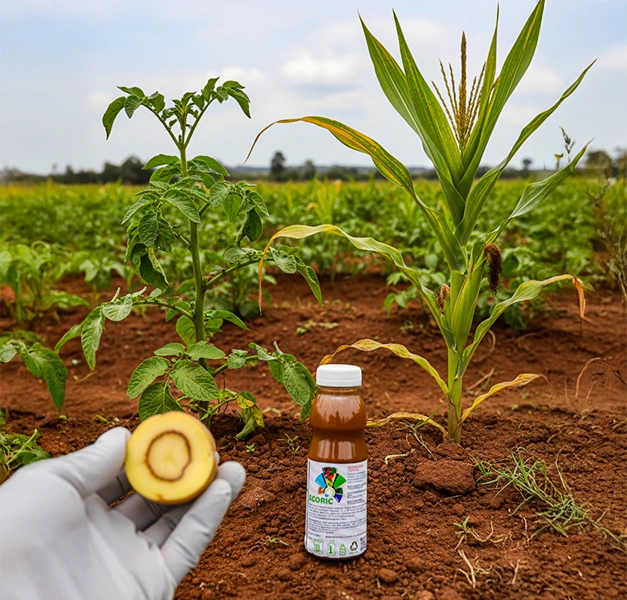
In the fertile fields of Kenya, from the Rift Valley to the Central Highlands, farmers face a dual threat that can wipe out an entire season's investment in weeks. Bacterial Wilt (BW) in potatoes and Maize Lethal Necrosis (MLN) in corn are known as "silent killers" because they often bypass standard chemical treatments and strike with devastating speed.
Understanding how to diagnose these early and integrating biological solutions like EcoRic is the only way to secure your food supply and profit.
- The Early Warning Signs: Diagnosis
- Bacterial Wilt (Ralstoniasolanacearum) – The Potato Menace
- The "Noon Wilt": The very first sign is a single leaf or branch drooping during the hottest part of the day, then recovering at night.
- The Slimy Cut: If you cut a suspected potato tuber in half, look for a brown ring. Squeeze it; if a milky white slime (bacterial ooze) appears, it is Bacterial Wilt.
- Rapid Death: Unlike fungal wilts which yellow slowly, Bacterial Wilt leaves often stay green while the whole plant collapses suddenly.
- Maize Lethal Necrosis (MLN) – The Corn Catastrophe
- Yellow Streaks: Look for bright yellow mottling on the leaves, usually starting from the base of the youngest leaves.
- Dead Heart: The center of the plant (the "heart") begins to dry up and die while the outer leaves may still look green.
- Empty Cobs: If the infection happens early, the plant produces no ears at all or very small, deformed cobs with few grains.
- Strategic Recommendations withEcoRic
Since traditional fungicides cannot "cure" a virus (MLN) or reach deep-seated soil bacteria (BW), your best strategy is Bio-Priming and Immune Activation using EcoRic.
- Seed & Tuber Treatment (The Shield): Before planting, spray potato tubers or soak maize seeds with EcoRic (1-2 L per ton). The Bacillus subtilis BR-1256 creates a protective biofilm around the roots, physically blocking Ralstonia from entering.
- Soil Drenching (The Cleanup): Apply EcoRic through irrigation or drenching (2 L/ha). The beneficial microbes outcompete pathogens in the soil and improve the "biological activity," making the environment hostile for "silent killers."
- Foliar Spray (The Vaccine): Apply at the 3-5 leaf stage for maize and before hilling for potatoes. This triggers Induced Systemic Resistance (ISR)—essentially "vaccinating" the plant so its immune system can fight off viral stress and secondary infections.
- EconomicImpact & ROI Calculation
The cost of inaction is a 100% loss. The cost of protection with EcoRic is a fraction of your harvest value.
Example: 1 Acre of Maize (Potato results are even higher)
| Metric | Traditional Chemical Approach | Integrated EcoRic Approach |
| Product Cost (per acre) | KSH 8,000+ (High fungicide/insecticide use) | KSH 4,000 (EcoRic + 30% less NRC) |
| Yield Loss Risk | 40% - 100% (High disease pressure) | 5% - 15% (Controlled pressure) |
| Average Yield (Bags) | 10 - 15 bags | 25 - 30 bags |
| Net Profit Increase | Low/Negative in outbreak years | KSH 30,000 - 50,000 surplus |
Economic Logic:
- Reduced Fertilizer Cost: EcoRic makes phosphorus and nitrogen more available, allowing you to reduce mineral fertilizer application by 30-50%.
- ROI: For every KSH 1 spent on EcoRic, the farmer typically recovers KSH 3 to 5 in saved yield and reduced input costs.
Conclusion
You cannot wait for the plants to die before acting. In Kenya's climate, prevention is the only cure. By using EcoRic, you aren't just fighting a disease; you are building a resilient farm ecosystem that protects your pocket and the nation's food security.
Stop the "Silent Killers" before they start.